Write a Character Art Brief Your Artist Can Use
Put the order, visible details and reference notes in one agreed brief. This filled example shows what to send and where to leave room for interpretation.
 Jan
4 min read
Jan
4 min read
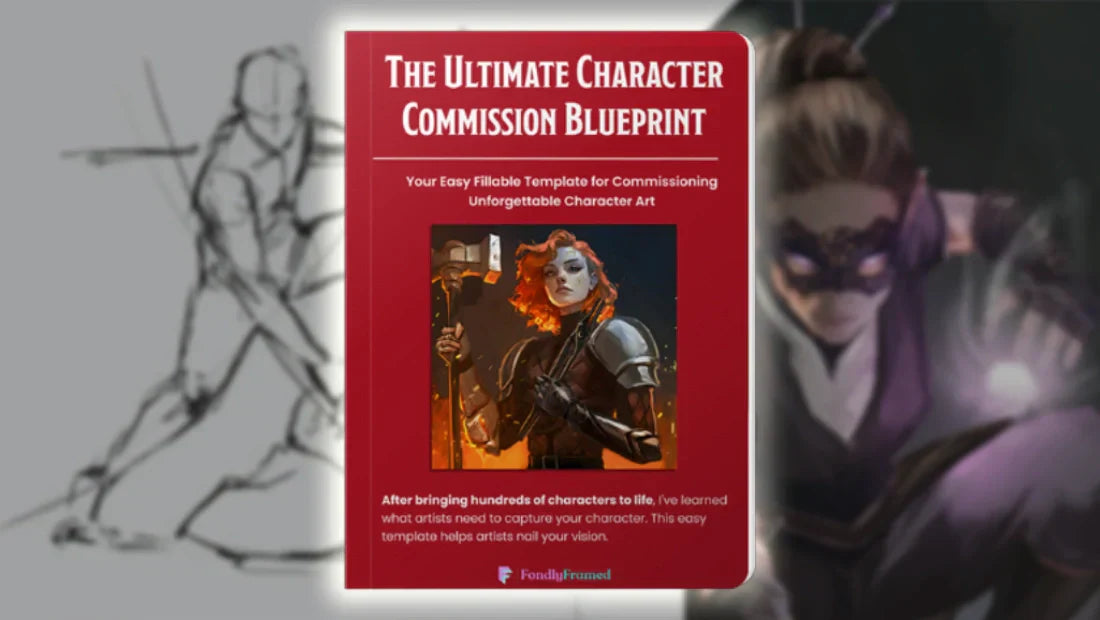
You know the character who has been getting you into trouble every Thursday. The artist still needs to know what goes in the picture. Give them a small, organized brief they can refer to while working.
Start with the order itself, then the visible details, the mood and the references. Mark which decisions are fixed and where you welcome interpretation. You can keep the long backstory nearby without asking it to do the work of a picture description.
Put the artwork request at the top
Your first lines should say how many subjects you want, which crop you are considering and where you will use the image. Include a real deadline if there is one, with enough context to distinguish receiving a file from receiving a framed gift.
“One thigh-up portrait for my personal character sheet” is a workable starting point. “A gift of the whole party in our ruined tavern” opens several questions about subjects, setting and delivery. Both can be good briefs once those questions are answered.
FramedFantasy offers half-body, thigh-up and full-body portraits. Choose the crop around your important details. A boot tattoo needs a frame that includes the boot.
Separate fixed details from room to interpret
Make two small lists. In the first, put the features whose absence would make the picture wrong for you. In the second, put things you would enjoy but can discuss.
That distinction helps when a pose, crop or lighting choice hides something. If the family pendant must be visible, say so. If the exact cloak fastening is flexible, the artist can choose a solution that fits the picture.

Fill in a concise working brief
Here is a fictional example. It is a writing model, not the original brief behind any portrait shown here.
| Field | Example answer |
|---|---|
| Artwork | One thigh-up portrait of Neri, my traveling wizard. Personal character-sheet use. |
| Appearance | Adult with short copper hair, brown skin and round spectacles. A wide silver streak begins above the left temple. |
| Clothing | Dark teal coat with repaired cuffs. Please keep the coat practical, with room to move the arms. |
| Must appear | Silver hair streak, spectacles and an open notebook held in the left hand. |
| Mood | Looking up from a note with an amused, attentive expression. She has spotted something worth investigating. |
| Flexible | Background colors and the exact position of the free hand. No required scenic landmark. |
| References | My sketch for hair-streak placement. My coat photo for the fastening only. My earlier portrait for face shape, with permission to share it. |
| Questions | Can the notebook fit in this crop? What are the total, final file dimensions and expected approval stages? |
You can copy those field names into an email or a document and replace every answer. Unknown details can stay marked “open to discussion.” You do not need to invent eye flecks at midnight because a template has a blank box.
Label what you want from each reference
A reference image can contain twenty things you did not mean to request. Give each one a short note. “Use the bow curve, ignore the clothing” is more useful than an unlabeled link.
Keep the original image or source link available and explain what permission you have to share it. A reference is a way to communicate choices. It is not an automatic request to copy another artist’s whole picture.

For visual organization, use the mood-board guide. Keep this brief as the place where your final choices are recorded.
Resolve contradictions before the artist starts
Read the brief once as if you had never met your character. Does “hood up” hide the hairstyle you called essential? Can both hands hold weapons while the notebook remains open? Which version wins if the sketch and written description disagree?
Put the answer beside the conflict. For example, “The current written description overrides the old sketch. Keep the silver streak on the character’s left, even if the reference photo is mirrored.”
Then keep one agreed version, with a date or clear filename. A short confirmation such as “This is the version to paint, with the notebook held in the left hand” gives both of you something concrete to check.
Send the brief and invite the useful questions
Ask the artist to flag unclear parts before the order is locked in. Their composition advice can help you choose which detail needs more space and which can remain subtle.
Use the first-commission guide for the wider buying process. If you are ready to work with FramedFantasy, bring your brief to the current portrait offer. A clear starting description leaves more room for a good conversation about the picture.