How to get art of your D&D character (even if you can't draw)
You know exactly what your character looks like. Now try showing someone else. Here's every way to make that happen.
 Jan
8 min read
Jan
8 min read
You know exactly what your character looks like. You've known since session two. The way they hold their staff, the color of their eyes, the scar that runs from their left temple to their jaw. You can see them perfectly when you close your eyes.
Now try showing someone else what you see. That's the problem.
If you can't draw, getting a visual of your character feels weirdly difficult for something that should be simple. There are more options than you think, though. Some are free. Some cost money. Some are better than others for different reasons. I've spent years inside the D&D character art world, and here's an honest rundown of every path I've seen players take.
Character creators and model builders

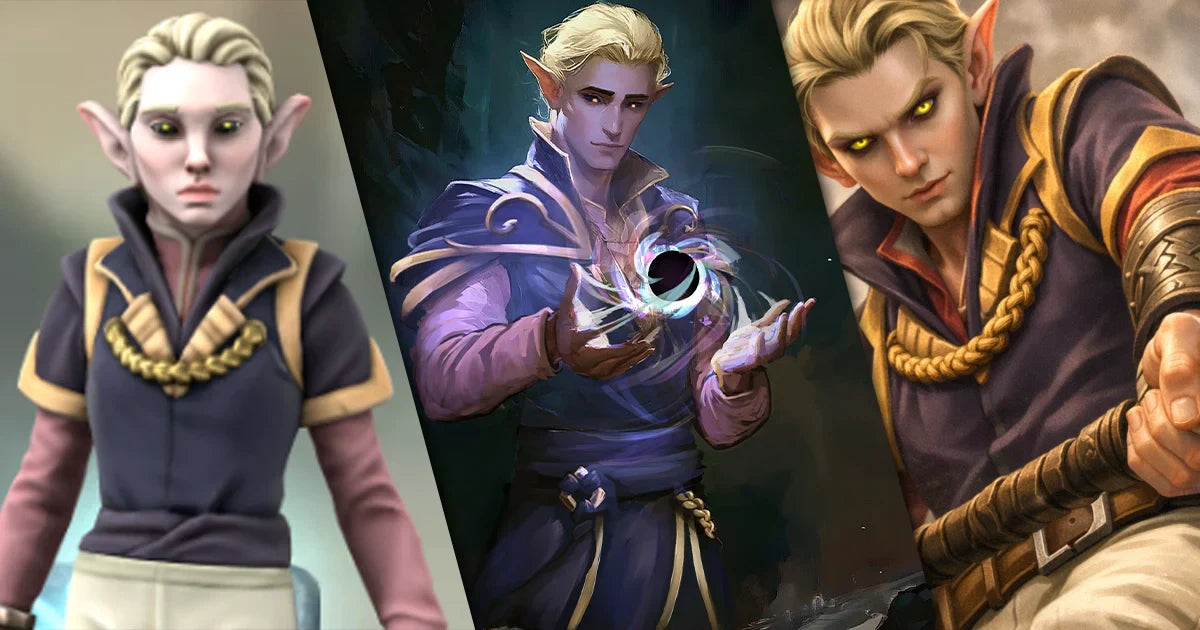
This is where most players start. Tools like HeroForge let you build a 3D model of your character by selecting body type, face shape, armor, weapons, pose. It's free to build (you pay if you want to print the mini or download a high-res image).
The upside is speed. You can have something that roughly looks like your character in 20 minutes. It's great for VTT tokens or giving an artist a starting reference if you commission something later.
The downside is that every HeroForge model looks like a HeroForge model. The faces all share the same plastic quality. The expressions are limited. And if your character has something unusual going on (blue flames, a missing eye, fungal growths, whatever weird thing makes them THEM), the tool probably can't handle it. You end up with something that's 70% right and missing exactly the parts that matter most.
I've had hundreds of clients send me HeroForge screenshots as references. They're genuinely useful for pose and outfit, but almost every person follows up with "but the face isn't right" or "imagine this but with more personality." The tool gets you started. It rarely gets you finished.
AI art generators

I'm not going to pretend this isn't complicated. AI generators can produce stunning fantasy art in seconds. And a lot of D&D players use them.
But I'll be direct about the problems because nobody else seems to want to.
Consistency is terrible. You can get a gorgeous portrait of a tiefling warlock on your first try and then spend two hours trying to recreate the same character in a different pose. The face changes every time. The outfit shifts. The horn shape mutates. If you're trying to build a consistent visual identity for a character you play weekly, this is a real problem.
Detail accuracy is hit or miss. Tell it "scar over the left eye" and you might get a scar over the right eye. Or no scar. Or a scar that looks like a lightning bolt instead of a blade wound. The more specific your character is (and most D&D characters are very specific), the more you'll fight with the generator to get things right.
And then there's the community factor. A lot of D&D players and artists have strong feelings about AI generated art. Posting an AI portrait in some D&D groups will get you roasted. Using one in official published content can get you disqualified from awards. If how other players perceive your character matters to you, know that AI art carries baggage right now.
That said, AI can be useful as a concept tool. If you have zero visual reference for your character and need something to react to ("yes that vibe, but darker," "that hair but shorter"), a quick generation can help you figure out what you want before investing in something more permanent.
Looking at what other players have done

This one gets overlooked constantly, and I think it's actually one of the most useful steps.
Before you spend any money or wrestle with any tool, go look at how other players have handled your exact race and class combination. If you're playing a tiefling warlock, look at ten other tiefling warlocks. See what other players did with the horns. See how they handled the patron relationship visually. Notice what color palettes keep showing up and which ones stand out.
Reddit (r/characterdrawing, r/DnDart) is good for this, but it's a firehose. You're scrolling through thousands of posts hoping to find your race/class combo.
I built the Hall of Heroes partly for this reason. It's a community character gallery where players submit their characters with portraits, backstories, race, class, and campaign info. You can filter by race and class directly. Want to see every tiefling in the gallery? One dropdown. Want to narrow it to tiefling bards? Two dropdowns. You can read their backstories, see how other players visualized them, and heart the ones you connect with.

It's free to browse and free to submit your own character with whatever image you have. A HeroForge screenshot, a photo you drew on a napkin, an old commission, whatever. Your character gets a permanent page with its own URL you can share anywhere.
The reason I think this step matters is that seeing real examples from real players sparks ideas that templates and generators don't. You'll see a tiefling warlock with moth wings instead of bat wings and think "oh wait, I never considered that." Or you'll read a backstory that reframes how you think about your own character's visual identity. Browsing other people's characters is free, it's fun, and it tends to crystallize the vision you already have in ways that staring at a blank character creator can't.
Commissioning a real artist

This is the expensive option and I'm obviously biased because it's what I do for a living. But I'll try to be fair about when it makes sense and when it doesn't.
A commission makes sense when your character has reached the point where they mean something to you beyond "fun build I'm trying out." If you've been playing them for a few months, if you know their face, if you have opinions about which shoulder the pauldron sits on and what shade of blue their eyes are, a real artist can capture that in a way no generator or model builder can.
A commission probably doesn't make sense for a character you just rolled for a one-shot you're playing this weekend. Too much investment for too little attachment. Use a character creator for that.
The scary part for most players isn't the cost. It's the process. How do you describe what you see in your head to a stranger? What if they get it wrong? What if they ghost you after you pay?
I work on every FramedFantasy commission with my team of vetted artists. Having the details organized helps us understand your character. Bring clear physical traits, useful reference images and an expression you can describe. Tell us what must stay and where we can explore.
If you want help organizing all of that, the character brief guide explains what to include. Use the advice to prepare an editable document for whichever artist you choose.
The option most players don't think about

There's a fifth path that nobody writes about in these roundups because it's not a tool or a service. It's photography.
If you cosplay your character (even partially), a decent photo can be a stronger character reference than any digital tool. I've had clients send me photos of themselves in costume and those commissions are always the easiest because I can see exactly how the armor sits, how the fabric drapes, how the weapon is held. The proportions are real.
You don't need a full costume. A cloak, a specific piece of jewelry, the right hairstyle, face paint for the markings. Even a rough approximation photographed in decent lighting gives an artist more useful information than a paragraph of text description.
Obviously this doesn't work for characters whose body is fundamentally different from yours (good luck cosplaying a 7 foot dragonborn). But for the human, elf, and tiefling players out there, it's worth considering.
So which option should you pick?
Depends on where you are with the character.
Brand new character you're still figuring out? Character creator. Get something rough. Play a few sessions. Let the character develop before you invest.
Got a character you love but you're not ready to spend money? Browse the Hall of Heroes for inspiration, submit yours with whatever image you have, and let the community see them. You might even win a free portrait in the monthly giveaway.
Character that's become part of your identity, the one you've played for months and will remember for years? That's when a commission pays for itself. Not in money. In the feeling you get when you finally see them the way they've always looked in your head.
Frequently asked questions
What's the cheapest way to get art of my D&D character?
Free options include HeroForge (for building a 3D model), AI generators (with the caveats mentioned above), and community galleries like the Hall of Heroes where you can submit your character and potentially win a free portrait. For paid options, commissions from artists on platforms like Etsy or direct websites typically start around $50 for simple portraits and go up from there depending on complexity and detail.
How do I describe my D&D character to an artist?
Start with the physical basics (race, build, skin/hair/eye color, distinguishing marks). Then add the details that make them unique (how they carry themselves, their expression, specific gear). Include reference images from any source, even bad ones. A HeroForge screenshot with notes like "this pose but the hair is longer and darker" is more useful than three paragraphs of text. If you want a structured approach, grab a free character brief template to organize everything before reaching out.
Where can I browse D&D character art for inspiration?
Reddit (r/characterdrawing, r/DnDart) has massive volumes of character art posts. Pinterest is good for building mood boards. The Hall of Heroes is a filterable gallery of real D&D characters with portraits and backstories, searchable by race and class. ArtStation has professional fantasy art if you're looking for style references for a future commission.