Hall of Heroes: the free D&D tools nobody's talking about yet

Hall of Heroes: the free D&D tools nobody's talking about yet

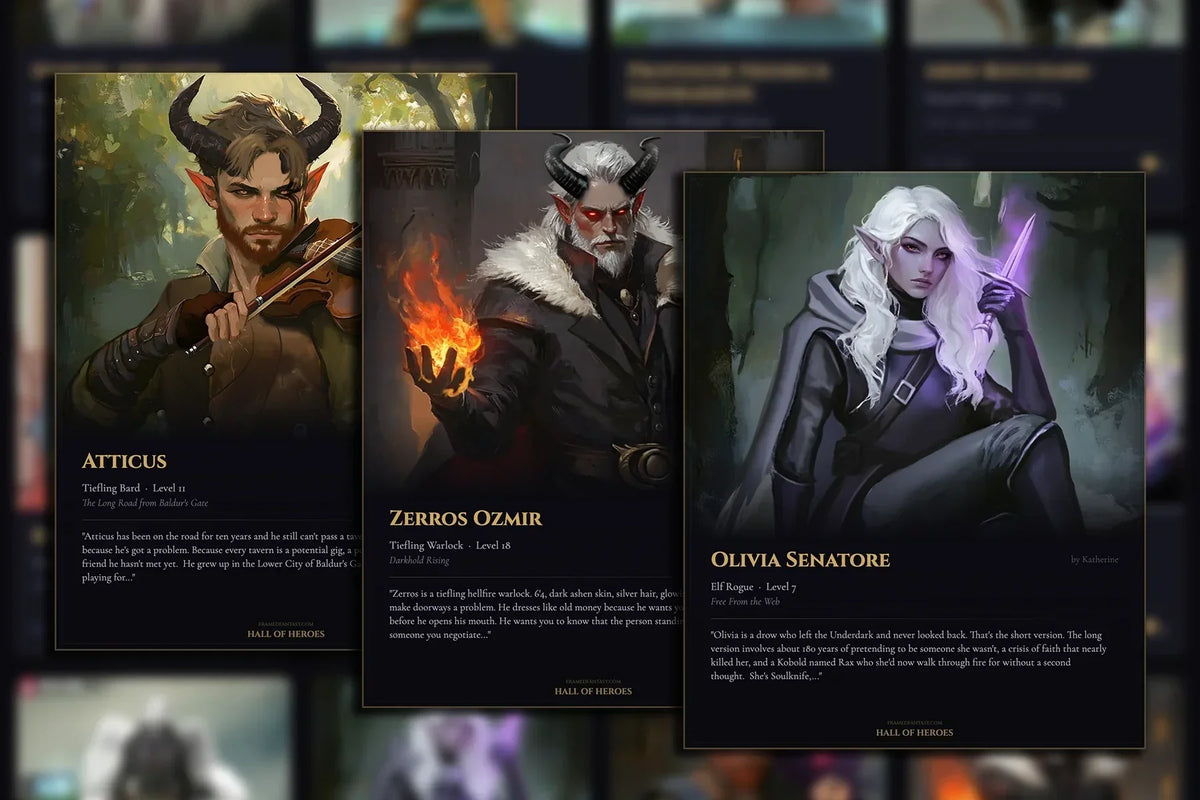
I built the Hall of Heroes to give D&D characters somewhere permanent to live after the campaign ends. That was the original pitch. Players submit their character, upload their art, write their story, and the character gets a permanent page other players can find.

Then something I didn't expect happened. The more characters showed up, the more it started to feel like a resource, not just a gallery. So I started building tools on top of it. DM tools specifically. Scene generators, tavern builders, stat block generators, a party creator that uses real submitted characters as the party members. All of it free, all of it working off the same growing pool of community-submitted heroes.

What that means is this. Every tool in the Hall gets better every time someone else submits a character, because the pool it draws from gets deeper. The scene generator doesn't give you a generic adventurer. It gives you Kael the cold-flame genasi. The tavern's patron isn't a random NPC. It's somebody's actual D&D character with a full backstory you can click into. Your DM tools are running on other people's heroes.

This post walks through every feature. If you're a player looking for a new bookmark, or a DM looking for free prep tools, read to the end. There's a feature hidden behind a coin flip that I'm going to tell you about if you make it that far.

The gallery (the foundation)

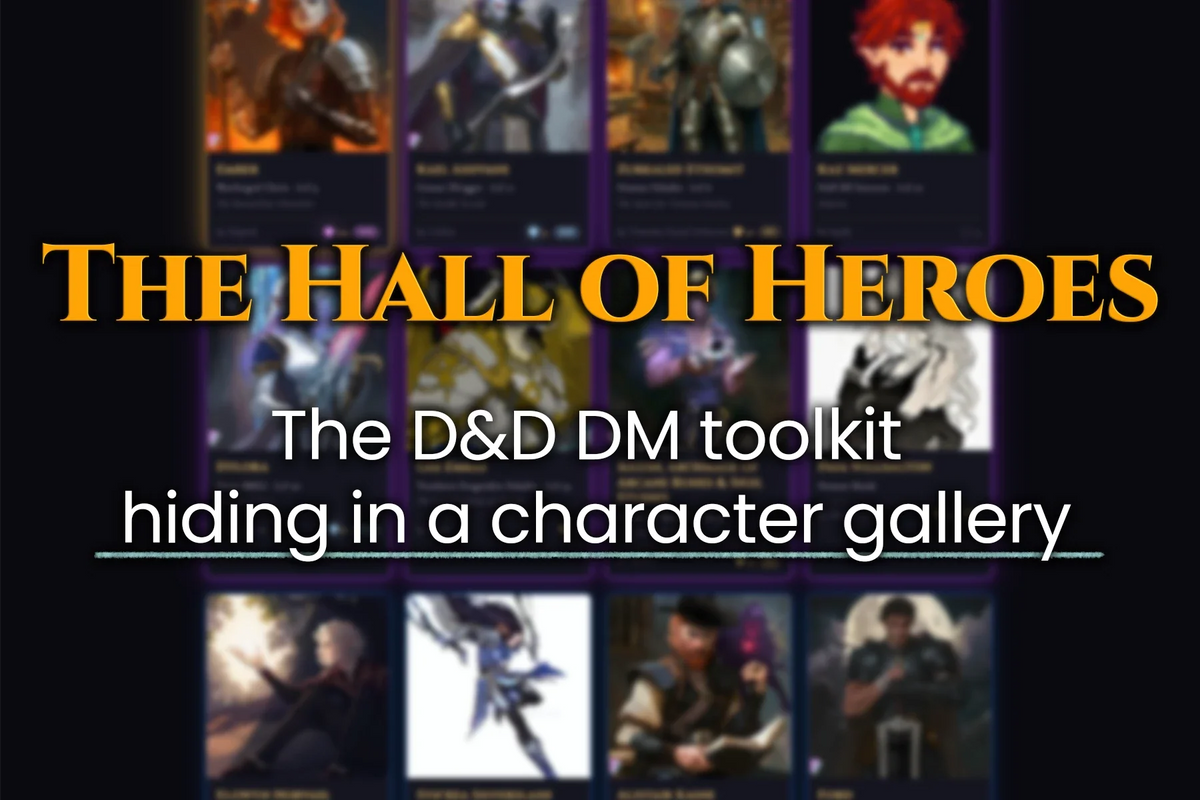
The front of the Hall is a browseable gallery of every approved character players have submitted. Each card shows the portrait, the name, race, class, level, and the campaign name. Click into any card and you get the full view. Full image at size, player name, the whole story the submitter wrote, a shareable link, and a hearts button that lets you upvote the character.

You can filter the gallery by race, class, level bucket, or campaign. You can sort by newest, most hearts, featured, or your own likes. Search works across names. It's a real browseable archive, not a landing page.

Why it exists. Player characters are invisible to everyone outside their table. A wife doesn't know what her husband's tiefling warlock looks like. A Discord friend has never seen the party you've been playing with for three years. The Hall is the first place where those characters get to exist outside the head of the person who plays them.

The DM's Satchel

The Satchel is a cluster of DM tools tucked behind icons on the Hall page. Every tool draws from the character gallery, which is the thing that makes them feel different from every other D&D generator on the internet. Most generators give you a wall of made-up names. These give you real characters other real players submitted. Let's go through each one.

Scene generator

One-tap tavern scene prompt. You hit the button and get three things. A "who," pulled from the gallery. A "they want," pulled from a pool of 108 hand-written desires (someone's looking for a missing brother, someone's running from a broken contract, someone wants a stolen heirloom back). And a "complication," pulled from 100 hand-written obstacles.

You can reroll any of the three independently. The "who" doesn't repeat within the session. If you want to filter the character pool down to characters you've hearted, you can. Once the scene is built, you can download it as a shareable image.

Why it exists. Half the time a DM needs a scene, they need it in the thirty seconds between one room and the next. Not a full prep session. Thirty seconds. The scene generator is for those thirty seconds. You get a character with a want and a wrinkle, and your session keeps moving.

Tavern generator

Five fields, all rerollable independently. Tavern name (from 100 hand-written names). Atmosphere (from 60). Special on the menu (from 60). A patron who's drawn from the character gallery. And a rumor the patron might be overheard saying (from 100+).

The whole thing composites into one printable card you can save as an image for your session notes.

Why it exists. Taverns are where most D&D sessions start and where most party downtime happens. A good tavern needs atmosphere, a menu quirk, at least one interesting patron, and a piece of gossip worth following. Most DMs improvise three of those four things, forget one, and the scene falls flat. The tavern generator fills in all five in about two seconds, and because the patron is a real player-submitted character with an actual backstory, your players can interact with them meaningfully if they want to.

Gather a Company

This one's my favorite. You pick a scenario (smugglers, rivals, noble household, cult cell, caravan, thieves' guild, troupe, or tavern regulars). You pick a party size (two, three, four, or five). The tool pulls that many real characters from the gallery and sends them, plus the scenario, to an AI party generator.

You get back a party name, a party hook, each member's role and bond to the group, and a DM hook for how the party connects to your campaign. You can export the whole thing as a clean PDF.

Every party you generate gets cached. If someone else picks the exact same combination of characters later, the cached party loads instantly. Each character you include gets a "table use" counter bumped, which I'll come back to when I explain the raffle.

Why it exists. Generating a full NPC party from scratch takes a real DM an hour of prep. You need names, classes, builds, a reason they're together, a reason they matter to your players. Gather a Company does all of it in twenty seconds, and every member is already visually fleshed out because they're an actual submitted character with a portrait. Your party walks into a thieves' guild and meets four characters who already have faces, stats, and stories.

There's a daily cap of three generations per user, which exists partly to keep costs sane and partly because any DM who needs more than three generated parties in one day is probably prepping wrong.

The Pouch (dice tool)

A polyhedral dice roller with real advantage and disadvantage support and a modifier adjustment from minus five to plus five. Pick your die (d4, d6, d8, d10, d12, d20), pick your mode, set your modifier, roll.

Roll a natural 20 and you get a confetti burst with visual effects. I built that part because it's funny, not because it's useful.

Why it exists. Sometimes you forget your dice. Sometimes you're at a coffee shop and want to roll up a quick random encounter. Sometimes you just want to see the confetti go off on a nat 20. The Pouch is the low-stakes always-available dice roller for those moments.

NPC card generator

Open any character's detail page and scroll down. If the character doesn't already have a stat block, the NPC card section generates one automatically. You get a proper D&D 5e-style stat block based on the character's race, class, level, campaign, and backstory. Copy it to your clipboard with one click. Or export it as a PDF that includes the character's portrait.

Every stat block gets cached the first time it's generated, so once it exists, it loads instantly for every future visitor.

Why it exists. DMs want to use other people's characters as NPCs in their own campaigns. This is the fastest path. You see a character you like in the Hall, you generate their stat block, you drop them into your session as a boss, a mentor, a rival, whatever. The creator gets credit. The character gets more life. You get a fully statted NPC for free in ten seconds.

The Random NPC Summoner

A button that picks a completely random approved character from the Hall and drops them into the NPC card UI. If you want to filter down by archetype (a shopkeeper, a guard, a noble, a traveler), the summoner tries to match on class and name keywords.

The reveal runs through an animated ticket reel before it lands on the character, which is both fun to watch and gives you a second to decide if you want to keep this one or reroll.

Why it exists. "I need an NPC right now" is the most common DM emergency. Generic name generators give you nothing to work with. The Summoner gives you a real character with a real face, a real backstory, and a generated stat block, all in one beat.

The Heart system

Every character in the Hall has a hearts count. You can give any character up to three hearts total. You get three base hearts to spend per day. Once a day, you can unlock three bonus hearts. Hearts are the currency of the Hall.

Hearts do two things. They let submitters see which of their characters resonated most with the community, which matters more to most submitters than you'd guess. And they feed the monthly raffle, which I'll get to in a second.

Why it exists. Because the Hall would be lifeless without a way for visitors to react to what they see. Hearts are simple, they're low-commitment, and they make the gallery feel like a living place instead of an archive.

Trial of the Heart

This one is intentionally hidden, so I'll say two things about it and leave the full discovery for when you find it yourself.

First, it's a Tinder-style swipe interface. Ten cards a day. Ten hearts to spend. Drag right to heart a character, drag left to pass. At the end, you get a marquee of the characters you hearted and a confetti burst.

Second, it's not available by default. You have to find it. I'll tell you where to look at the end of this post.

The monthly raffle

Every month, one character in the Hall gets picked as the winner, and the player who submitted that character wins a free commissioned portrait from me.

The draw is weighted, not random. Every character's entry count is hearts plus "table use" count (how many times they've been drawn into a generated Company) plus NPC card exports. The more people interact with the character across the Hall's tools, the more raffle entries they get.

When the draw runs, you can watch an animated ticket reel scroll through every entry in the drawing before it lands on the winner. Confetti included.

Why it exists. The raffle is the single honest way I can reward the community without paywalling anything. Submit your character for free. Get interacted with by other players. Maybe win a free portrait. That's the loop. And it's genuinely weighted by engagement, so submitting a character with a compelling portrait and backstory actually matters.

The Character Quest

Separate from the Hall but worth mentioning because a lot of Hall visitors discover it. The Character Quest is a five-minute interactive D&D adventure at /quest. Dice phases, narrative branches, audio, the whole experience. At the end, you get a character blueprint based on the decisions you made during the quest.

It's a completely different experience from the gallery. I mention it here because there's a floating quest icon on the Hall page, and a lot of players assume it's a decoration. It isn't. Click it and the whole quest opens.

Submitting your own character

This is the participation path. At the top of the Hall there's an "Add Your Hero" button. Click it and you get a form with fields for name, race, class, level, campaign, player name, your character's story, and up to two images.

You don't need to have a commissioned portrait to submit. The form accepts any image you have — your token, your D&D Beyond portrait, a sketch from a friend, a photo of a mini. If you don't have an image at all, the character still submits and shows with a styled letter placeholder.

Submissions go through approval. Approved characters show up in the gallery within a day or two. Once approved, your character gets a permanent page, a shareable link, and gets added to the pool every DM tool draws from.

Why it exists. Because the whole system only works if real players put their characters in. Every tool I've described in this post gets better the bigger the pool gets. That's the flywheel.

Alright, you made it. Here's the coin secret.

In the DM's Satchel, among the other tools, there's a coin flip. On the surface it looks like a dumb little feature. A spinning coin. Heads or tails. You flip it, it lands, it tells you the result. Fine.

It's not just a coin flip.

The coin tracks your heads streak across a session. The more heads you flip in a row, the weirder the subtitle text under the coin gets. Hit a high enough streak and the coin reveals a new button in the Satchel. That button is the entry point to Trial of the Heart, the hidden tinder-style swiper I mentioned earlier.

You have to flip the coin enough times to hit the streak. You have to actually pay attention to the subtitle text changing. And if you're patient, the hidden door opens.

That's the secret. I built it that way on purpose. The Hall rewards people who explore it. Most visitors miss Trial of the Heart entirely because they don't bother with the coin. That's the cost of not poking around. Now you know.

If you haven't been to the Hall yet

This is the door. Every tool in this post is behind it. No signup. No paywall. Browse, try the tools, submit your own character if you want. That's it.

Frequently asked questions

What is the Hall of Heroes?

The Hall of Heroes is a free community gallery of D&D characters submitted by real players, with a suite of DM tools built on top. It includes a scene generator, tavern generator, AI party generator, dice roller, NPC stat block generator, a hidden daily swipe game, and a monthly raffle that gives one submitted character a free commissioned portrait.

Do I need to sign up to use the Hall of Heroes tools?

No. The scene generator, tavern generator, NPC card generator, dice tool, and gallery are all accessible without an account. Submitting your own character requires filling out a form, but browsing and using the tools is completely free and anonymous.

Are the DM tools actually usable in a real session?

Yes. The scene generator gives you a character-want-complication trio in one tap. The tavern generator builds a full tavern card you can save as an image. Gather a Company generates a full party with a scenario, hook, and individual bonds in about twenty seconds. Every tool outputs in a format you can drop into a session mid-game.

How do I submit my D&D character to the Hall of Heroes?

Click the "Add Your Hero" button at the top of the Hall page, fill out the form with your character's name, race, class, level, campaign, player name, story, and optional image, and submit. Submissions go through a quick approval step and typically appear in the gallery within a day or two.

How does the monthly raffle work?

Every character in the Hall earns raffle entries from hearts received, how many times the character has been drawn into a generated Company, and how many times their NPC stat block has been exported. At the end of each month, one character is drawn using weighted random selection, and the player who submitted that character wins a free commissioned portrait.

More Blogs
CHARACTER QUEST

Which Archetype Does Your Character Actually Belong To?

A 5-minute D&D quest with real dice. Custom card and full blueprint at the end.

5-minute D&D quest Real dice rolls and a story-driven adventure that maps your character's true nature.
Custom archetype card A shareable visual reveal at the end. Yours to keep, post, or send to your party.
Character blueprint A complete description any artist can use to bring your character to life.
Find Your Archetype

500+ characters named so far

Hall of Heroes

0 heroes.
Every one has a story you haven't heard.

Summoned from hundreds of tables.
Gathered into one Hall.

Enter the Hall