FramedFantasy Hall of Heroes: the D&D DM toolkit hiding in a character gallery
The FramedFantasy Hall of Heroes looks like a character gallery. That's how I describe it on the homepage. That's how most DMs find it.
The thing is, somewhere along the way it stopped being a gallery and turned into a working D&D session prep toolkit. Scene generators, tavern builders, faction creators, NPC stat block generators, dice, all powered by a growing pool of real player-submitted characters. Most DMs who land on the Hall scroll the gallery for two minutes and leave without realizing they just walked past six free tools that would have fixed last week's session.
This post is for those DMs. I'm going to walk through six specific moments every DM has been in. The ones where you're hunched over your laptop at 11pm and you need a thing right now. For each moment I'll describe what the dream tool would do. Then I'll show you the one I built into the Hall.
Read to the end. There's a feature hidden behind a coin flip that almost nobody finds, and I'll tell you how to unlock it.
Why this is different from every other "best D&D tools" list

If you've searched for D&D DM tools before, you've seen the same article fifty times. A list of ten disconnected products you have to bookmark separately. Notion for notes, Tabletop Audio for music, Kobold Fight Club for encounters, three different name generators, a dungeon mapper, a virtual tabletop. Nothing talks to anything else.
The Hall of Heroes is one site, with one shared character pool, where every tool feeds the next. The patron the tavern generator gives you is a real character with a backstory you can click into and a stat block you can export to PDF. The faction Gather a Company builds is made of those same characters, with bonds between them and a hook for your campaign. The random NPC the summoner pulls already has a portrait and a story another player wrote.
That's the difference. Not a list of tools. An integrated D&D session prep environment built on top of a real player community.

Moment 1: It's Sunday night and your prep folder is empty (Scene generator)
You promised yourself you'd prep on Friday. You didn't. You promised again on Saturday morning. Didn't happen. Now it's Sunday at 10pm, the session is Tuesday, and you have nothing.
What you actually need isn't a 4-hour prep session. You need a single starting scene. One character your players can walk up to. One thing that character wants. One complication that gets in the way of getting it. If you had that, you'd have an opening, and the rest of the session usually writes itself once the players take the bait.
So the dream tool is a single button that hands you those three things in five seconds.
That's the Scene generator in the Hall's DM Satchel. One tap. You get a "who" pulled from the character gallery (so it's a real submitted character with a face and a backstory), a "they want" pulled from a hand-written pool of 108 desires, and a "complication" pulled from a hand-written pool of 100 obstacles. Each piece rerolls independently if you don't like one. The whole scene composites into a downloadable image you can keep in your prep folder.
Sunday night just got shorter.

Moment 2: Your party walks into a tavern you forgot to plan (Tavern generator)
This one happens to every DM. Your players say "we go to the inn for the night" and you realize you never wrote down the name of the inn, what's on the menu, who else is drinking there, or what they might overhear. You've got maybe ten seconds before someone says "what's the place called?" and the silence becomes obvious.
The dream tool is something that gives you a fully-furnished tavern in the time it takes your players to roll perception. A name. An atmosphere. A weird thing on the menu. A patron worth talking to. A rumor that patron might let slip if your party buys them a drink.
That's the Tavern generator. Five fields, all rerollable. The patron is pulled from the character gallery, which means it's a real player-submitted character with a backstory you can click into if your players actually engage. So when one of your players asks "what does this guy look like," you've got an answer. When another asks "what's his deal," you can riff off a real story instead of making one up under pressure.
This is the use case the gallery integration changes most. A random tavern patron from a name generator is a forgettable NPC. A tavern patron whose full backstory exists in the Hall is a thread your players can pull on if the night takes a turn.

Moment 3: Your players want to talk to "the smugglers" you mentioned offhandedly (Gather a Company)
Three sessions ago you said something like "the docks have been overrun with smugglers lately." It was a throwaway line. World-building texture. You didn't actually plan a smugglers' faction.
Now your players have decided that the smugglers are the most interesting plot hook in the campaign. They want to find them, infiltrate them, possibly join them. You need a smugglers' faction by Thursday. Names, roles, leadership structure, motivations, a hook that ties them to your campaign.
The dream tool is one that takes a scenario like "smugglers" and an arbitrary number like "four members," and hands you a complete faction with characters who already have faces, backstories, and stat blocks.
That's Gather a Company. You pick a scenario from eight options (smugglers, rivals, noble household, cult cell, caravan, thieves' guild, troupe, tavern regulars). You pick a party size of two to five. The tool pulls real characters from the gallery, sends them through an AI faction generator with the scenario, and gives you back a faction name, a hook, every member's role and bond to the group, and a DM hook that ties them to your campaign. Export the whole thing as a PDF.
Twenty seconds. A faction your party walks into Thursday night that feels like you spent the week building it. This is the tool no other D&D site has, because no other D&D site has a community character pool to draw from.

Moment 4: They went off-script and you need an NPC right now (Random NPC Summoner)
Your party was supposed to head to the cursed forest. They've decided to go to the next town over instead. There's a market in this town. They want to shop. You need a shopkeeper, a couple of customers, a town guard, possibly a noble passing through, all in the next ninety seconds while one of your players is in the bathroom.
The dream tool is a "summon a random interesting NPC" button that gives you a full character, fast, with enough texture that you can riff on them for ten minutes if your party starts asking questions.
That's the Random NPC Summoner. One click, you get a random character pulled from the entire approved gallery. If you want to filter by archetype (a shopkeeper, a guard, a noble, a traveler), you can. The reveal runs through an animated ticket reel before landing on the character, which is honestly fun to watch and gives you a beat to decide if you want this one or want to reroll.
The character you summon already has a portrait, a backstory, a campaign they came from, and a stat block (or you can generate one in two more clicks). Your players walk up to a stall and find a character somebody else built. Real depth, zero prep.

Moment 5: You found a character you want to drop into your campaign as a boss
You're scrolling the Hall and you find someone's level 20 villain. Drow rogue, complicated motivations, the kind of character you'd never have built yourself but that fits perfectly into the slot you've been trying to fill in your own campaign. You want to use them.
In a normal world, this means writing up your own stat block from scratch using their description as a reference. An hour of work, easy.
The dream tool is a button that takes any character in the Hall and gives you a balanced D&D 5e stat block, ready to run, with the character's portrait attached and a clean PDF export.
That's the NPC card generator. Open any character's detail page, scroll down, and the stat block either loads instantly (if someone else has already generated it) or auto-generates the first time you open it. Copy it to your clipboard. Or download it as a PDF that includes the portrait, the backstory, and the full stat block formatted for table use.
Real characters, real stat blocks, ten seconds. The original creator gets credit. You get a fully-formed villain.

Moment 6: Your players ask what other people's campaigns look like (the gallery itself)
This one's softer than the others. It happens between sessions, usually in the group chat. Someone asks if anyone's seen a cool homebrew campaign lately. Someone else asks for character build inspiration. You realize the answer used to be "scroll Reddit for an hour and hope something good shows up."
The dream tool is a browseable archive of real D&D characters from real campaigns, with backstories, builds, levels, and the campaign names they came from. Filterable by race and class. Sortable by what the community found most interesting.
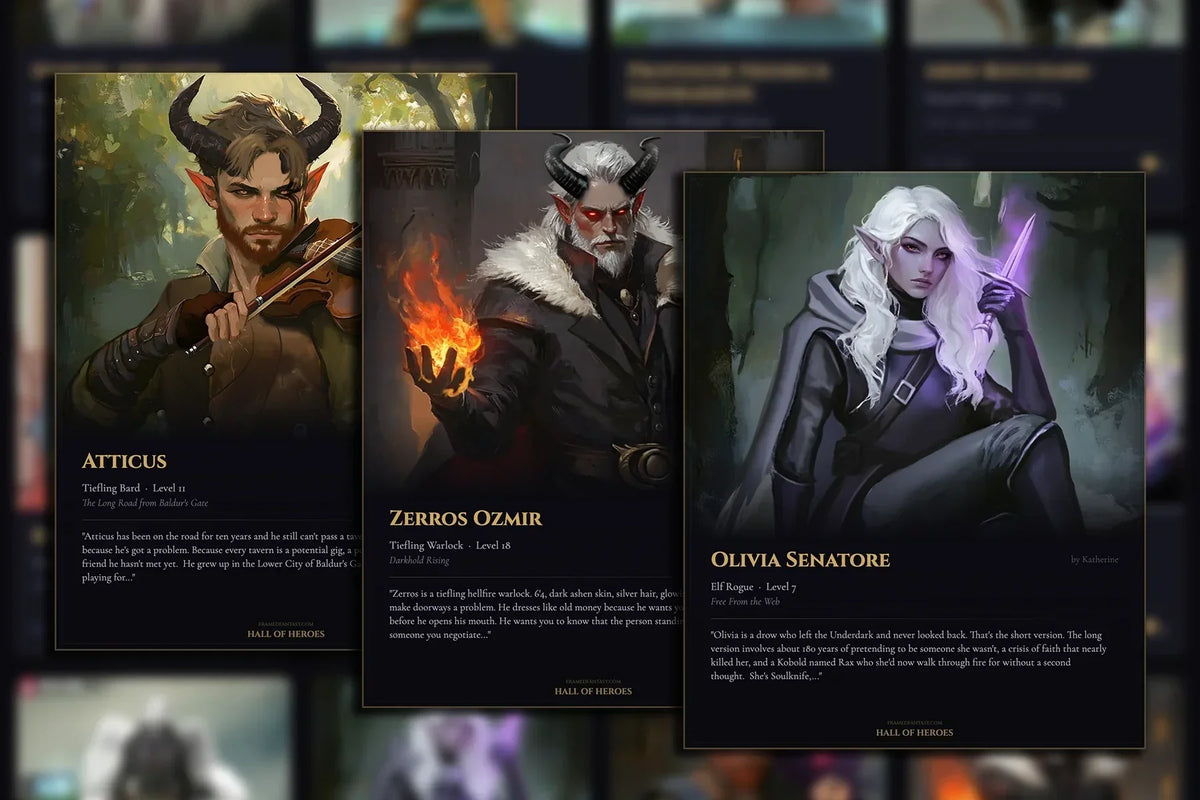
That's the gallery itself. The piece most visitors think the Hall is and don't realize is just the foundation of everything else. Every character submitted to the Hall gets a permanent page with their portrait, race, class, level, campaign, and the full story their player wrote. You can filter by race, class, level bucket, or campaign. You can sort by newest, most hearts, featured, or your own likes. You can search by name.
When your players want inspiration for their next character, this is the link you send them. Here's a deeper post on using the gallery for character inspiration. When you want to see what other DMs' homebrew worlds are producing, scroll the campaign filter. It's the closest thing the D&D community has to a public character archive that isn't locked behind a Discord server.

Why all of this is free
I should be upfront about this. I run FramedFantasy. I paint custom D&D character portraits for a living. The Hall of Heroes lives on the FramedFantasy site and the tools cost money to run.
The reason everything is free is that the Hall only works if real players keep submitting their characters to it. The tools all draw from the same pool. Every new character makes every tool better. If I gated submissions behind a paywall or made the tools require an account, the pool would shrink, and the whole system would die. So none of it is gated. You can use every tool I described in this post without ever giving me an email address.
If you ever want a portrait of your own character, that's the part I sell. I wrote a separate guide on how to commission a D&D portrait if that's where you're at. Until then, the Hall is just a thing I built and run because I think the D&D community deserves it. That's the deal.
The monthly raffle and how to actually win it
One last thing every DM should know. Every month, one character in the Hall gets selected as the raffle winner, and the player who submitted that character wins a free commissioned portrait from me. The draw is weighted, not random. Every character earns entries based on hearts received, how many times they've been used in a generated Company, and how many times their NPC stat block has been exported.
If you submit your character and other DMs use them in the tools (as a Company member, as an NPC export), you accumulate raffle entries automatically. Submitting a compelling character with a portrait and a strong backstory is the thing that wins. Not gaming the system. Just submitting the kind of character other DMs actually want to use at their tables.
The hidden coin secret
Alright. You made it. Here's the thing I promised at the start.
In the DM Satchel, alongside the scene generator and the tavern builder and the dice tool, there's a coin flip. It looks like a throwaway feature. Spinning coin, heads or tails, fine.
The coin tracks your heads streak across the session. The more heads you flip in a row, the weirder the subtitle text underneath the coin gets. Hit a high enough streak and a new button appears in the Satchel. That button unlocks Trial of the Heart, a daily Tinder-style swipe game where you get ten cards from the gallery and ten hearts to spend on the ones you like best. End of the session, you get a marquee of your favorite characters and a confetti burst.
Most visitors miss it because they treat the coin as a gimmick. It isn't. It's a hidden door, and the streak is the key. Now you know where to look.

If you've been hearing about the Hall and never visited
This is the link. No signup, no paywall, no email gate. Browse the gallery. Try the DM tools. Submit your own character if you want to be in the pool other DMs are pulling from. That's the whole thing.
If you want a deeper feature-by-feature walkthrough of every tool in the Hall, here's the full tool tour.
Frequently asked questions
What is the FramedFantasy Hall of Heroes?
The FramedFantasy Hall of Heroes is a free community gallery of D&D characters submitted by real players, with a suite of free DM tools built on top of it. Tools include a scene generator, tavern builder, AI faction generator, dice roller, NPC stat block generator, and a hidden daily swipe game. Every tool draws from the same gallery of real submitted characters.
Who is the Hall of Heroes for?
The Hall is built for two audiences. D&D players who want a permanent home for the characters they've spent years playing. And dungeon masters who want free, fast, integrated session prep tools that pull from a pool of real player-submitted characters instead of generic name generators.
Do I need to commission a portrait to use the Hall of Heroes?
No. Every tool in the Hall is free to use without any account, email, or purchase. Submitting your own character to the gallery is also free. Commissioning a portrait from FramedFantasy is a separate paid service, not a requirement to use the Hall.
How do DMs use the Hall of Heroes for D&D session prep?
Most DMs use the Hall in three ways. The Scene generator gives them a character-want-complication trio for opening or filler scenes. Gather a Company gives them a full faction or NPC group with names, roles, bonds, and a DM hook. The Random NPC Summoner gives them a single NPC with a portrait, backstory, and stat block whenever their party goes off-script. All three tools draw from the same pool of real submitted characters, which is what makes the output feel fleshed out instead of procedurally generated.
How is the Hall of Heroes different from other D&D NPC generators?
Most D&D NPC generators randomize attributes from a fixed list. They produce characters that are statistically valid but feel hollow because no one ever played them. The Hall of Heroes pulls from a pool of real player-submitted characters, each with a backstory written by the person who actually ran them at a table. The output feels like a person because it was a person at someone's table. That's the structural difference.
Is the Hall of Heroes part of the 1989 D&D sourcebook of the same name?
No. The 1989 Hall of Heroes was a Forgotten Realms sourcebook published by TSR. The FramedFantasy Hall of Heroes is a separate, modern, free community gallery and DM tool suite built in 2026. They share a name and a spirit (both archive D&D characters worth remembering) but they are unrelated projects.